Writing
AI creative agency: one brief, a consistent campaign
updated 2026-09-17
An AI creative agency helps turn one business brief into a coordinated campaign: images, video concepts, ads, a landing page, and social posts. The useful part is keeping the product and message consistent across all of them. The tools help make the assets. Someone still has to direct and review the work.
That is the service I offer. We start with what you sell, who needs it, and what you want them to do. Then we agree on the deliverables and a quote. Ask about a project.
What is in this guide?
- Who this helps
- What you can receive
- How we keep the work consistent
- The process and review
- Scope, cost, and getting started
Who is this for?
This service is for marketing assets that need a consistent message. Your website and ads may make different promises, or each batch of AI images may change the product. You may also have a good offer that is hard to explain.
A single website or a short consulting call may be enough for a smaller need. Those are separate services. We can keep the project small.
What do you get?
We choose a set of deliverables around your goal. These are the areas we can include in the proposal. The agreed scope determines which assets are finished files, concepts, scripts, or production instructions.
| Area | Practical deliverable |
|---|---|
| Brand strategy | A one-page brief: audience, offer, message, evidence, and next step |
| Creative direction | Three distinct directions, followed by one approved direction |
| Creator-style video | Concepts, scripts, shot lists, captions, and generation prompts |
| Product imagery | Studio, lifestyle, and campaign concepts with protected product details |
| Paid ads | Hooks, images or video concepts, headlines, and a clear action |
| Landing page | Structure and copy that carry the same offer through the page |
| Organic social | A seven-post sequence with different angles on the same message |
| Review and revisions | Specific corrections to product details, claims, visuals, and copy |
An AI presenter can demonstrate an idea. It cannot supply a real customer's experience. I keep fictional characters distinct from customer testimonials. Our character reference guide shows how we maintain a fictional cast across images and scenes.
What is a Brand Lock?
A Brand Lock is a short working document that lists the details we keep fixed across the campaign.
| Keep fixed | Allow to vary |
|---|---|
| Product name, shape, packaging, and logo | Setting and camera angle |
| Offer, price, and supported claims | The opening hook |
| Core colors, typography, and tone | Format and composition |
| The action you want people to take | The example used to explain it |
For example, a product can appear on a kitchen counter in one image and in a studio in another. Its label and shape should not change. A different hook can introduce the offer; it should not invent a different offer.
How does the work run?
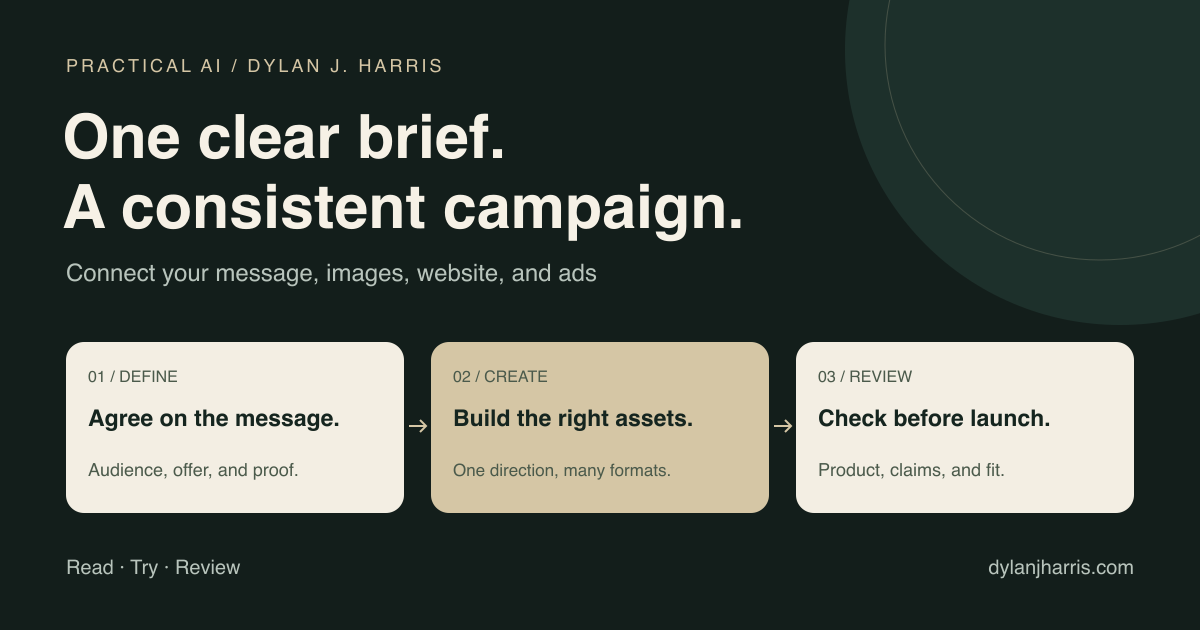
We agree on the message before making a batch of assets. That gives each review a clear standard.
- Discover. Share the product, audience, goal, and existing material. A voice note is fine.
- Define. Agree on the brief, deliverables, quote, and schedule. Mark assumptions that still need an answer.
- Choose. Review the creative directions and approve the Brand Lock.
- Create. Build the agreed assets. Keep scripts, prompts, and source material with them.
- Review. Check the actual output and make focused corrections.
- Improve. Use real feedback or campaign results to decide what to change next.
A simple starting brief can be this short:
We sell: [product or service]
Our audience: [who needs it]
Their problem: [one specific problem]
Our offer: [what they receive]
Our evidence: [facts we can support]
Next step: [what the visitor should do]
Assets needed: [formats, channels, and quantities]
What happens in the review?
We check each asset against the agreed brief. Each issue gets a specific correction.
- Does the message fit the audience and offer?
- Are names, prices, claims, and product details accurate?
- Do faces, props, labels, and colors stay consistent?
- Does the asset fit its channel and size?
- Is the next step clear?
- Are there generation errors, awkward wording, or unnecessary elements?
For example: “The bottle label changes between shots. Use the approved label in both.” That gives us a repair we can check.
You approve publication and paid launches. If a tool cannot produce an agreed result, we discuss a revision or a handoff. A prompt file does not count as a finished video unless that is what we agreed to deliver.
What does it cost?
The campaign service is quoted per project. Brand complexity, asset count, formats, revisions, and schedule affect the scope. There is no fixed public package price.
A consultation is a separate starting option. It can help define the problem before committing to a larger project.
Get in touch with the product, goal, and a few examples. We can work out what would help first.
Frequently asked questions
Do you guarantee ad results?
No. Creative concepts are proposals to test. Results depend on the offer, audience, distribution, and other factors. We measure actual results rather than inventing a forecast.
Can I request only one part of the campaign?
Yes. We can scope a landing page, an image set, or another specific need. The full service is useful when several assets need a common direction.
Is creator-style AI video the same as customer content?
No. A fictional presenter is not a customer. Real testimonials require real customer material. We do not write invented experiences as if a person had lived them.
Can you deliver rendered video?
We can include rendered video when the tools and scope support it. We agree on the final format before work starts. Scripts and prompts can also be separate deliverables.
Do I need a finished brand guide first?
No. Bring what you have. The first phase can establish the small set of facts, visual details, and tone the campaign needs.